


ZONIX MOTION
Zonix Motion: Local IDE-Native AI Motion Graphic Agent with Autonomous QA and Zero-Infra Architecture
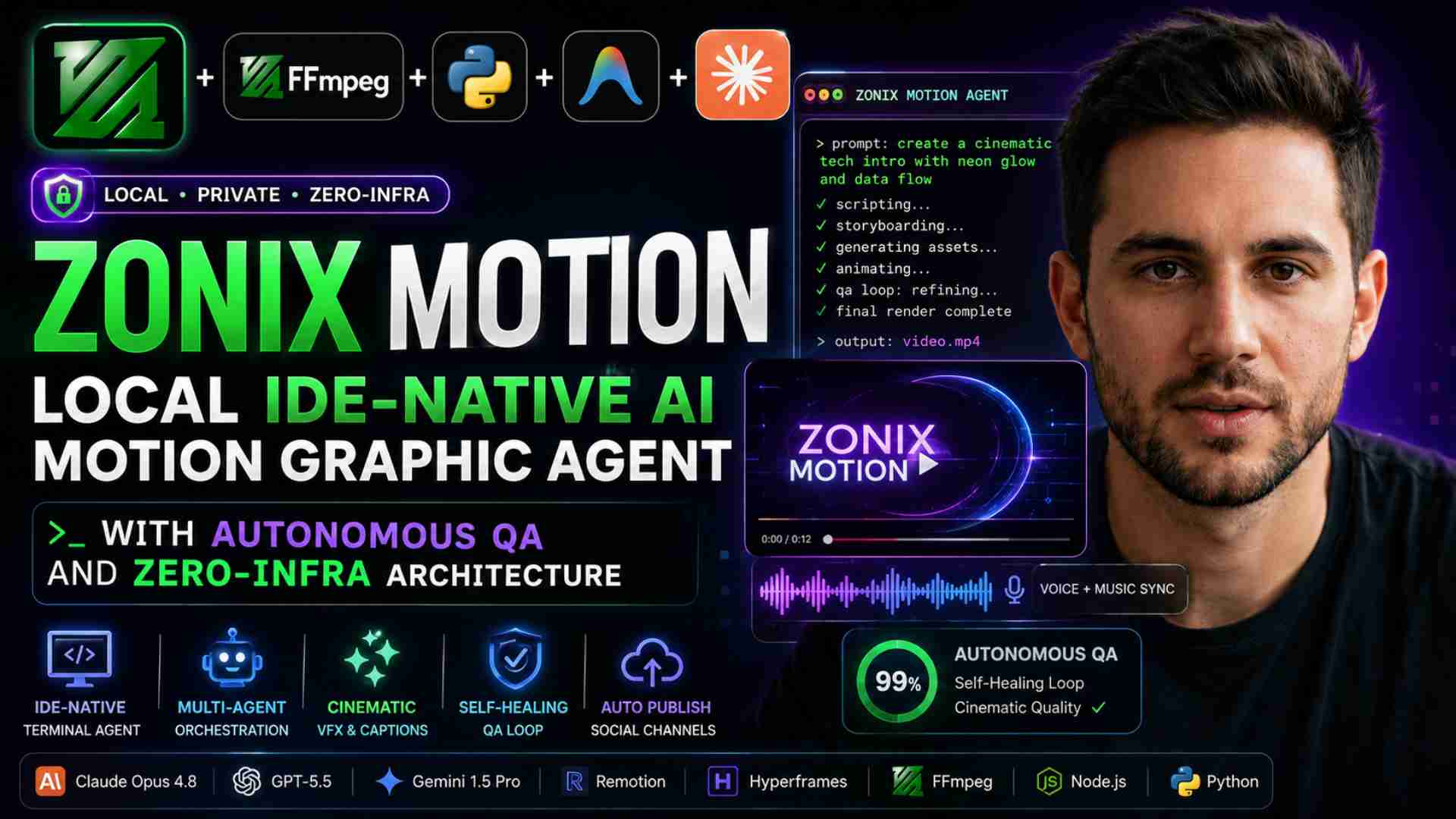
This project is a revolutionary, terminal-native Autonomous AI Motion Graphic Video Agent built as a zero-infrastructure developer utility that runs completely locally within an IDE environment. Rejecting the standard, high-maintenance SaaS model, this tool requires no databases, no external authentication layers, no paid platform subscriptions, and zero infrastructure overhead. Users interact with the agent solely through text-based prompts and scripts within their existing IDE terminals via advanced automation assistants like Claude Code, Codex, or Gemini CLI. Once a prompt is received, a localized multi-agent orchestrator calls frontier LLMs—such as Claude 3 Opus, GPT-5.5, or Gemini 1.5 Pro—to autonomously script, storyboard, and program the visual canvas. The backend engine compiles pure programmatic animation using an optimized Remotion Skill Set and Hyperframes Skill Set framework. The core system executes an autonomous Continuous Quality Assurance (QA) loop that inspects visual timing, fine-tunes kinematic motion, and iteratively regenerates assets without any human intervention until cinematic standards are met. Visual outputs feature high-fidelity procedural design elements including cinematic aura glows, dynamic responsive text captions, and precision-timed vocal alignment. It combines synthesized voiceovers with a user-selected background score (chill, cinematic, or dark ambient tracks). Final rendering is optimized directly on the user's host machine via a specialized Python-controlled FFmpeg core. As a final bonus automation, the tool utilizes localized terminal scripts to interface directly with target social media networks, enabling direct video publishing without going through costly enterprise distribution APIs. Core Tech Stack Claude Code / Codex / Gemini CLI: The native IDE execution environment serving as the primary user terminal workspace. Frontier LLMs (Claude Opus 4.8 / GPT-5.5 / Gemini Pro): The collaborative cognitive reasoning models driving script intelligence, scene planning, asset building, and automated code rewriting. Python Automation Core: The lightweight local controller orchestration layer managing the multi-agent execution flows, system processes, and QA evaluations. Remotion & Hyperframes Markdown Skill Matrices: Embedded local technical documentation files (.md) that guide LLMs to write precise, executable React-based programmatic animations. Local FFmpeg Architecture: The multi-threaded multimedia processing utility executed via Python to manage exact audio-visual syncing, layered blending, and rapid MP4 packaging. Node.js (Local Runtime): A plug-and-play local execution environment hosting the Remotion canvas container directly on the developer's hardware. Browser-Automation Hooks (Playwright/Puppeteer): Local system scripts used to securely route finalized MP4 files straight to connected social media platforms without utilizing paid third-party distribution APIs. Core Product Feature Matrix: 1. Zero-Config Local Setup (Install-and-Run) Infrastructure Independence: No setup configs, no database installations, and no Docker networks required. Users install a unified package script that immediately launches an isolated local workspace. Direct Token Usage: Operates entirely over the developer's local LLM API keys via their native IDE command setups, bypassing SaaS price markups. 2. Multi-Agent Scripting & Audio Orchestration Vocal Alignment & Script Splitting: The LLM expands the prompt into an exact storyboard, breaking text into timestamp blocks. Acoustic Soundscapes: Generates localized text-to-speech files and auto-mixes them with user-selected ambient music profiles (Chill beats, Cinematic scores, or Dark synth tracks). 3. Hyperframes Cinematic Execution Procedural VFX Canvas: Constructs high-end graphic assets featuring automated Aura glow shaders, neon highlights, fluid transition vectors, and particle motion graphics. Responsive Video Captioning: Parses vocal timestamp maps to project perfectly synced kinetic text overlays directly over visual objects. 4. Self-Healing QA Evaluation Framework Visual Frame Analysis: The Python controller checks the generated composition structure for rendering syntax or structural defects. Recursive Refinement: If a scene breaks or the audio overlaps, the QA loop feeds error readouts straight back to the LLM agent, continuously modifying code versions until the final output meets perfect rendering standards. 5. Localized Social Channel Distribution Zero-API Social Connect: Avoids complex developer portal approvals. The tool uses local web-scraping components and user session profiles to securely load, frame, and post completed videos right to active media handles.