


AI AGENCY WITH CLAUDE
AI Agency Command Center: Cross-Suite Multi-Agent Business Auditing, Tiered Proposal Generation, and PDF Reporting
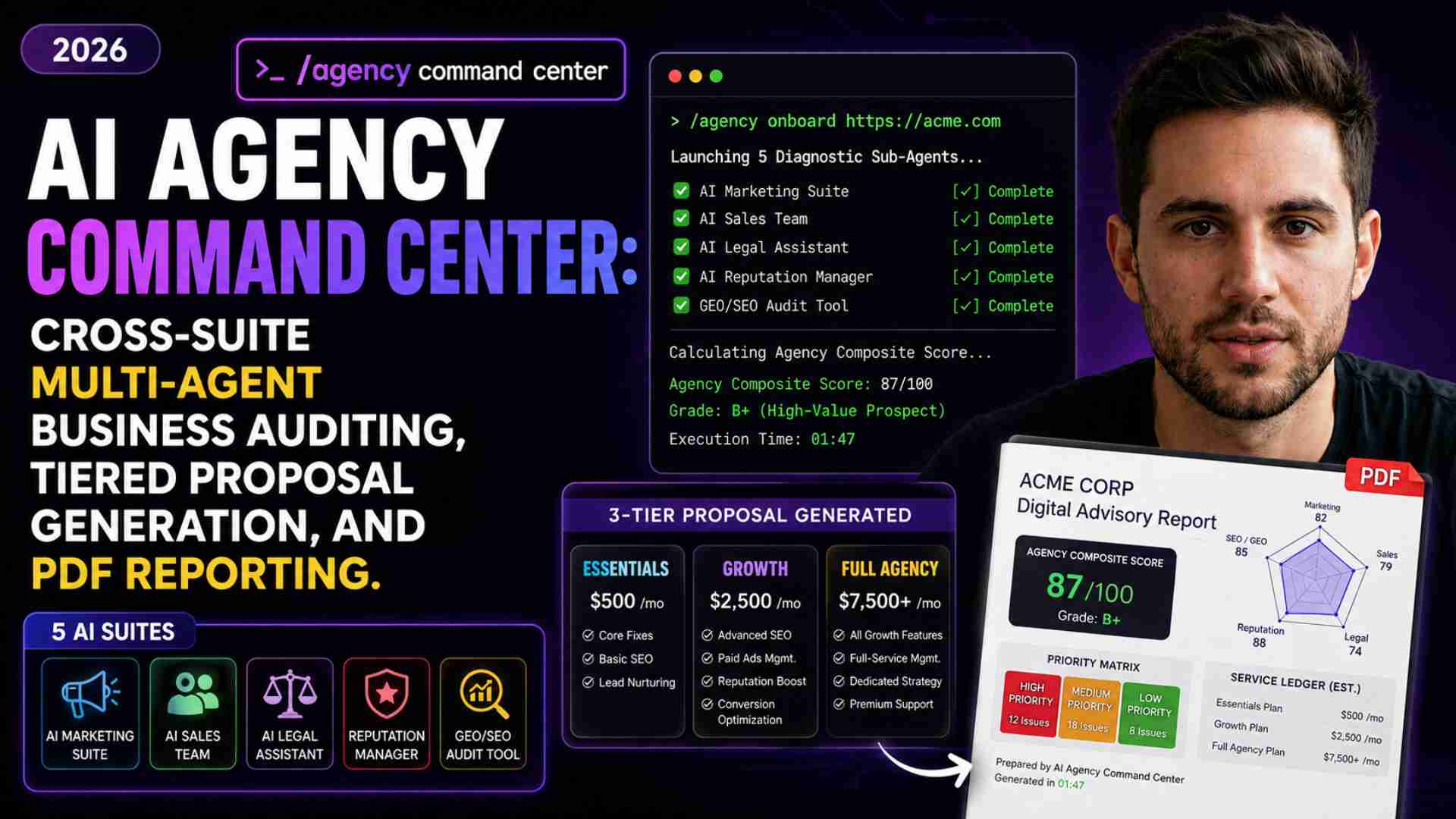
Overview Running a full-service digital agency typically demands significant overhead, specialized teams, and days of manual business auditing. AI Agency Command Center redefines this landscape by acting as a master orchestration layer that sits directly on top of 5 specialized AI tool suites within Claude Code. Operating completely from a centralized terminal workspace with zero employee dependency, this command-line engine simultaneously audits a prospect's digital footprint across multiple business verticals, computes an agency composite score, and drafts highly tailored client proposals in less than 2 minutes. Key Features & Technical Architecture The architecture is engineered as a multi-tenant synthesis framework that unifies individual workspace repositories into a single execution dashboard: Cross-Suite Parallel Orchestration: When triggered via the flagship /agency onboard command, the core orchestrator simultaneously deploys 5 isolated diagnostic sub-agents—AI Marketing Suite, AI Sales Team, AI Legal Assistant, AI Reputation Manager, and GEO/SEO Audit Tool—to run deep parallel audits on any target corporate URL. Algorithmic Business Scoring: It ingests diagnostic outputs across all 5 dimensions to calculate a weighted Agency Composite Score (0–100) and an associated letter grade, automatically targeting high-conversion "sweet spot" client profiles showing critical structural vulnerabilities. Automated Proposal & Commercial Frameworks: The tool contains a multi-dimensional proposal builder (/agency propose) that transforms diagnostic logs into complete, psychology-backed 3-tier sales agreements (Essentials, Growth, and Full Agency tiers ranging from $500 to $7,500+/month). Unified PDF Compilation: Integrating Python and ReportLab, the engine fuses data streams from all sub-suites into a publication-quality, comprehensive PDF advisory report complete with data visualizations, priority matrix blocks, and itemized service ledgers.